
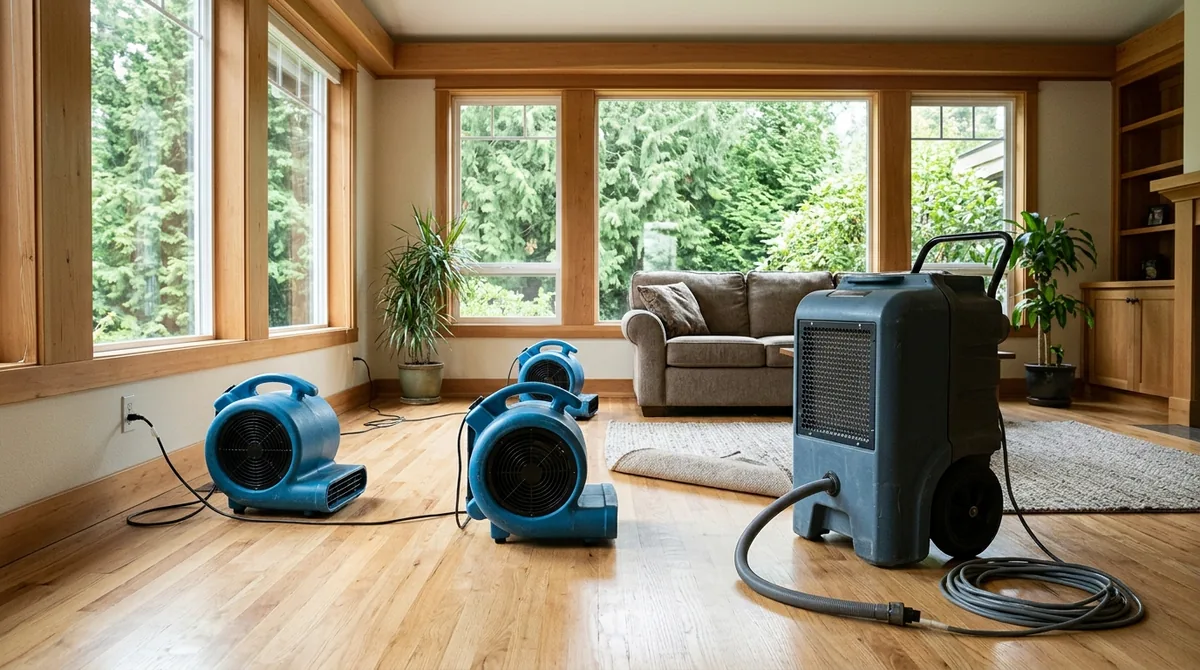
Under the IICRC S500 restoration standard, Category 1 (clean supply water) often allows salvageable carpet, hardwood, and intact drywall to be dried in place, whereas Category 2 (grey water) and Category 3 (black water from sewage or exterior flooding) require removing porous materials like carpet pad, insulation, and wicking drywall for occupant health safety.
When a water restoration technician walks into a flooded Burien home and announces, "This is a Category 2, Class 3 loss—we need to pull the carpet pad and flood-cut two feet of drywall," most homeowners wonder whether that tear-out is genuinely necessary or just extra demolition. Those terms are not arbitrary sales jargon. They come directly from the ANSI/IICRC S500 Standard for Professional Water Damage Restoration—the industry benchmark used by independent restoration contractors and Washington homeowners insurance adjusters alike. Understanding both Water Categories (contamination level) and Water Classes (evaporation load) helps you ask informed questions and verify that your home is dried safely without wasteful demolition.
The 3 IICRC Water Contamination Categories Explained
Water Category measures sanitation and health risk—where the water came from and what it touched before reaching your floor. Critically, water category is not permanent: clean water that sits unextracted for more than 48 hours or passes through dirty framing, dusty crawl space soil, or insulation degrades into a higher category.
| IICRC Category | Common Burien Sources | Health Risk Level | Standard Material Protocol |
|---|---|---|---|
| Category 1 (Clean Water) |
Broken copper/PEX supply line, water heater tank rupture, toilet tank (not bowl) overflow, clean sink faucet left running. | Low initially; degrades toward Category 2/3 if left wet over 48 hours. | Extract rapidly; carpet, hardwood, and intact uninsulated drywall can often be dried in place. |
| Category 2 (Grey Water) |
Washing machine discharge hose, dishwasher drain leak, sump pump failure (clean pit), toilet overflow with urine only. | Moderate—contains detergents, organic matter, and microbes that multiply rapidly. | Remove carpet pad and saturated insulation; clean & disinfect hard surfaces; evaluate carpet carefully. |
| Category 3 (Black Water) |
Main sewer backup, toilet overflow with solid waste, hillside rainwater/groundwater seeping through foundation walls, creek flooding. | High—pathogenic bacteria, viruses, parasites, and soil/chemical contaminants. | Containment + HEPA air scrubbing; remove all soaked porous materials (carpet, pad, drywall, insulation); disinfect & dry framing. |
Why Clean Rainwater Outside Becomes Category 3 Inside Your Basement
One of the biggest surprises for homeowners in Seahurst, Three Tree Point, and Shorewood is learning that rainwater leaking through a basement wall is treated as Category 3 black water. Rain itself falls clean from the sky, but the moment it runs across paved streets, lawns, fertilizer, pet waste, and soil around your foundation before seeping through concrete cracks, it carries outdoor bacteria and silt. That is why responsible basement flood cleanup after a winter storm requires removing soaked carpet pad and contaminated lower drywall strips rather than trying to dry muddy carpet in place.
The 4 IICRC Water Damage Classes (Evaporation Load)
While Category measures contamination, Class (1 through 4) measures how much water is absorbed and how hard it is to evaporate. Class directly drives how many LGR dehumidifiers, radial air movers, and drying days a crew needs during structural drying and dehumidification:
- Class 1 (Slowest evaporation rate / least absorption): Affects only part of a room with low-permeance materials like concrete, vinyl tile, or plywood—little or no wet carpet or drywall.
- Class 2 (Fast evaporation rate): Affects an entire room of carpet and pad, with moisture wicking less than 24 inches up walls and absorbed into structural framing.
- Class 3 (Fastest evaporation rate / highest absorption): Water came from overhead—such as an upstairs burst pipe soaking ceilings, walls, insulation, carpet, and subfloors simultaneously.
- Class 4 (Specialty drying situations): Bound water trapped inside dense, low-permeance materials like solid oak hardwood floors, plaster-and-lath walls (common in 1920s–1940s Olde Burien bungalows), concrete slabs, or crawl space heavy timber. Class 4 losses require lower humidity targets, specialty inject-dry equipment, and longer drying times.
Material-by-Material Decision Matrix: Dry in Place vs. Remove
Use this practical matrix to understand what independent restoration contractors typically recommend across Burien residential losses:
| Building Material | Category 1 (Clean Water) | Category 2 (Grey Water) | Category 3 (Black Water) |
|---|---|---|---|
| Drywall (uninsulated interior wall) | Often dried in place if intact and caught within 24 hours. | Remove wet sections above waterline; sanitize studs. | Mandatory flood-cut removal 12–24 in. above waterline. |
| Drywall holding wet fiberglass insulation | Flood-cut drywall so wet insulation can be removed and studs dried. | Remove drywall and insulation; sanitize stud cavity. | Remove drywall and insulation under containment; disinfect. |
| Carpet & carpet pad | Discard foam pad; extract & dry salvageable carpet if caught fast. | Discard pad; carpet usually removed unless specialty restoration approved. | Mandatory disposal of both carpet and pad. |
| Solid oak / Douglas fir hardwood | Often salvageable with immediate extraction + floor drying mats. | Case-by-case; subfloor sanitation required if water penetrated seams. | Typically removed due to trapped subfloor pathogens. |
| Laminate / MDF baseboards | Usually removed—particleboard swells irreversibly when wet. | Remove and replace. | Remove and dispose as contaminated debris. |
| Douglas fir studs & floor joists | Dry in place to dry-standard MC% (<15%). | Clean, apply antimicrobial, dry in place to target MC%. | Scrub, apply EPA-registered disinfectant, dry thoroughly in place. |
How Technicians Verify Moisture & Category Changes on Site
Determining water category and class is not a one-time guess made at the front door—independent mitigation crews re-evaluate conditions as they trace water through the structure. A leak that starts as clean Category 1 water inside a second-floor bathroom in Lake Burien or Boulevard Park can pick up dust, rodent droppings, or old insulation debris as it travels down framing bays into a crawl space, changing how lower materials must be handled.
During an on-site IICRC S500 inspection, technicians rely on three complementary tools:
- Infrared thermal imaging cameras: Detect subtle surface temperature differences caused by evaporative cooling behind painted drywall, tile backsplashes, and ceilings—pinpointing hidden wet pockets without punching exploratory holes across dry walls.
- Pinless (non-invasive) moisture meters: Scan hardwood planks, tile floors, and gypsum surfaces rapidly to map the exact perimeter of moisture migration.
- Pin-type (penetrating) moisture meters: Measure exact electrical resistance inside wood studs, bottom sill plates, and plywood subfloors to establish a numerical wood moisture content (MC%). Unaffected dry framing inside a typical Burien home usually reads between 8% and 12% MC; readings above 16% to 20% signal active drying is still required.
Before authorizing demolition, ask your technician to walk you through their moisture map and explain why each targeted wall or flooring section falls under Category 1, 2, or 3. Clear, meter-backed explanations protect you from both under-drying (which leaves hidden mold behind closed walls) and unnecessary tear-outs (which inflate reconstruction timelines).
Why Waiting 48 Hours Turns an Easy Category 1 Dry-Out Into Demolition
Time is the hidden multiplier in every Burien water loss. Suppose a clean supply line leaks behind a washing machine in Gregory Heights on Friday afternoon. If you call for emergency water extraction that evening, technicians can pull standing water out, detach baseboards, and dry intact drywall and solid wood framing in 3 to 4 days with minimal tear-out. If that same clean puddle sits untouched until Monday evening—over 72 hours later—water has wicked deep into gypsum paper, bacteria and mold spores have begun multiplying, and the loss has degraded toward Category 2/3, forcing drywall removal and antimicrobial remediation.
For homeowners dealing with a backed-up drain or sewer line right now, never wait or run household fans—review our sewage backup cleanup page immediately. To see how Water Category affects overall project budgets, test Category 1 vs. Category 3 scenarios in our Burien Water Damage Cost Calculator or return to our Burien water damage restoration homepage.
Frequently Asked Questions
Drywall sheets are installed horizontally in 4-foot widths. Cutting cleanly at 2 feet (half-sheet) or 4 feet (full-sheet) above the highest moisture reading removes wicking gypsum, lets wet insulation come out, and makes drywall replacement faster and cheaper to tape and blend.
Solid plywood cabinet boxes can often be dried in place after clean Category 1 water if toe-kicks are opened for airflow. Particleboard/MDF cabinets swell and crumble rapidly when soaked and generally require replacement.
Yes—under IICRC S500 guidelines, clean Category 1 water that sits unmitigated for more than 48 hours or contacts soiled building cavities can degrade into Category 2 or Category 3 due to microbial growth.